Whoa!
I’ve used a lot of blockchain explorers, and somethin’ about Solana tools hooks me quick.
At first it was curiosity — a need to verify a trade or check a token contract — and then the habit stuck.
My instinct said “fast, simple, and accurate” mattered more than bells and whistles, though actually, the interface surprised me with depth.
Initially I thought all explorers were the same, but then realized that access to transaction metadata and token histories can change how you trade and trust on-chain.
Seriously?
Yes — because speed on Solana isn’t just bragging rights; it shapes how you evaluate front-running, mempool behavior, and fee patterns.
The analytics matter when you’re watching a token launch from New York or doing a quick audit in a coffee shop in the Midwest.
On one hand the raw blocks are readable; on the other hand, you need curated views to make sense of noise.
This is where a focused token tracker and clean charts start to feel like having a map in a chaotic city.
Hmm…
Here’s the thing.
There are explorers that show you transactions and then there are explorers that tell a story about a token’s life — mint, transfers, burns, and who the big holders are, even if those holders hide behind a handful of accounts.
I say “tell a story” because when a liquidity pool grows odd overnight, a good explorer surfaces that narrative; without it you stare at rows of hex and get dizzy.
Sometimes I get excited, sometimes annoyed — and yes I’m biased toward tools that save me time when markets move fast.
Wow!
What bugs me is sloppy token pages that omit critical fields like supply verification or token decimals, which are very very important for sanity checks.
A broken token tracker can mislead traders, and I’ve seen wallets accidentally send ten times the intended amount because decimals were misread.
So a reliable explorer must surface the token mint details up front, and ideally cross-link contract audits or verified metadata if available, though audits aren’t always present.
Oh, and by the way… provenance matters — who created the token and how is the first liquidity added are often the canary signs.
Okay, so check this out—
I use solscan as the quick first pass.
It loads fast and gives me the token supply, recent holders, and swap history in clear sections, which is helpful when I’m doing a quick vet during a lunch break in SF.
My workflow is simple: validate the mint, scan recent txs for wash trading or suspicious minting, then dig into holder distribution if anything looks off.
If something felt off about a token, my gut tells me to pause and double-check the on-chain evidence before touching my funds.
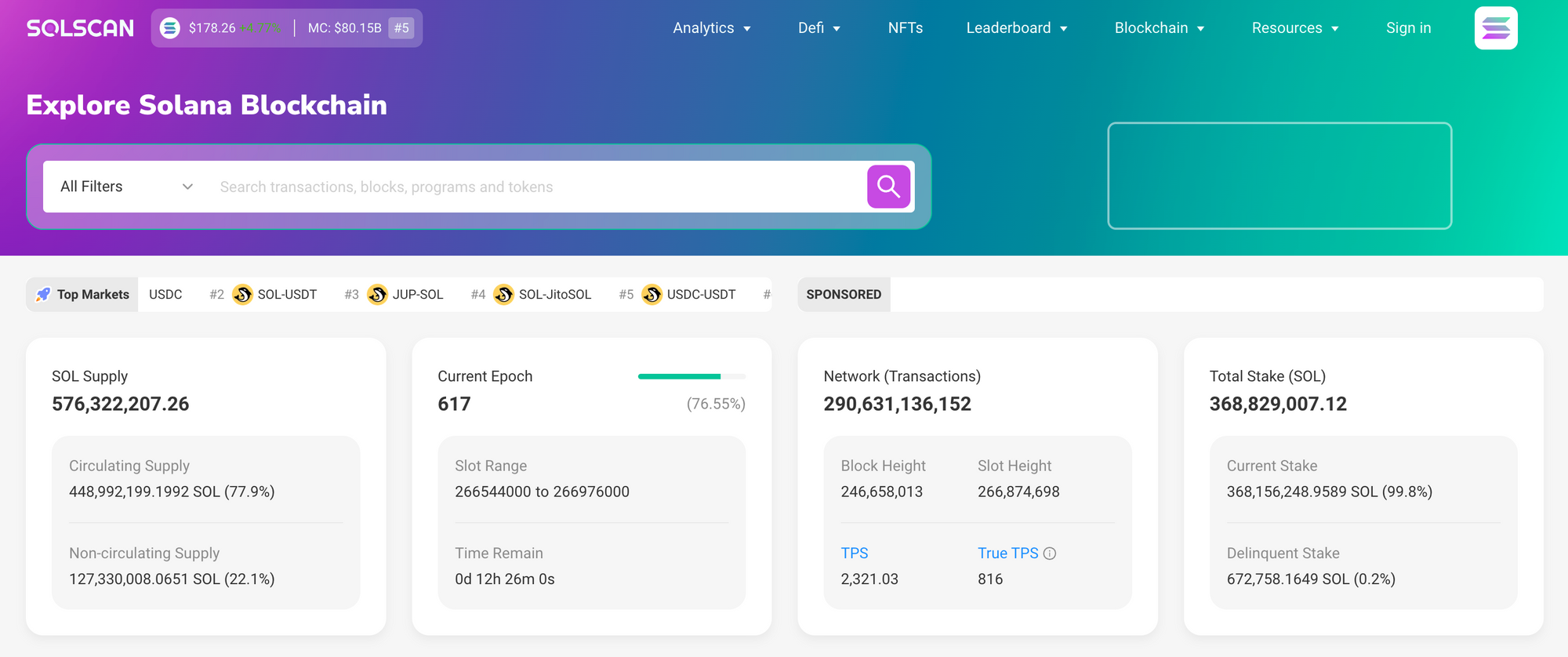
How solscan’s Explorer Helps with Solana Analytics
I’ll be honest — solscan isn’t perfect, but it nails a few things that traders and devs actually need.
The dashboard gives transaction-level details with decoded instructions, which is huge when evaluating complex token programs or multi-instruction swaps.
On the analytics side you get quick charts for daily volume, active addresses, and program activity, and those trends help you see momentum beyond noise.
Sometimes a spike in swaps is just bots; sometimes it’s organic interest — discerning that takes context that a good explorer supplies.
solscan is the place I point people to when they ask for a capable Solana scanner that balances depth and clarity.
My process looks like this: verify mint metadata, check holder concentration, inspect swap and liquidity changes, and review program calls for odd behavior.
On one hand those checks are straightforward; on the other hand they require an explorer that surfaces fields without making you hunt through raw logs.
Actually, wait—let me rephrase that: an explorer should make the obvious obvious and keep the complex accessible without clutter.
Seriously?
Yes, because accuracy and presentation are different things.
I’ve audited small token launches where the data was present but presented in a way that hidden manipulations were easy to miss until it was too late.
Good explorers provide both decoded instructions and links to related program accounts so you can trace assets across program interactions.
And if you care about wallets, a token tracker that highlights top holders and new entrants gives you a narrative instead of just numbers.
Whoa!
One feature I appreciate is the ability to follow a wallet or a token and get a quick snapshot later, which is handy when you sleep and the market doesn’t.
Alerts, bookmarks, or a persistent watchlist are small UX things that save brainpower when volatility hits.
My working assumption is that a tool should reduce the steps between suspicion and confirmation, which is why I lean on explorers that integrate search, decode, and simple visualizations in one place.
On a pragmatic level that reduces mistakes and keeps decision latency low during fast moves.
Hmm…
There are tradeoffs to know.
Decoding complex programs sometimes requires community-sourced decoders or external documentation, and solscan does a decent job but it isn’t omniscient.
On the other hand, if you’re developing, you might prefer raw RPC logs and a node connection for deeper debugging — explorers complement but don’t replace that workflow.
So: use the explorer as your reconnaissance tool and your node or local tooling as your lab when you need to reproduce or stress-test behavior.
FAQ — Quick Practical Answers
How can I verify a token’s true supply?
Check the token mint account details for supply and decimals, then cross-reference recent mint or burn instructions in tx history; if you see repeated mints to faucets or unknown accounts, take the token’s supply claims with skepticism.
Can I track whale movements on Solana?
Yes — look at holder distributions and recent large transfers, then track the receiving account’s behavior; large, consolidated transfers moving into a single account usually indicate coordinated activity, which you should monitor closely.
Is solscan suitable for developers?
For quick debugging and visual traceability it’s great; for full program-level debugging you’ll still want local tooling and RPC access, though the explorer often points you exactly where to dig.